Pothos vs Philodendron: How to Tell the Difference (With Photos)
TL;DR: "Pothos" is actually Epipremnum aureum, and the fastest way to tell it apart from heartleaf philodendron is the cataphyll sheath. Here is the definitive diagnostic guide with side-by-side photos.

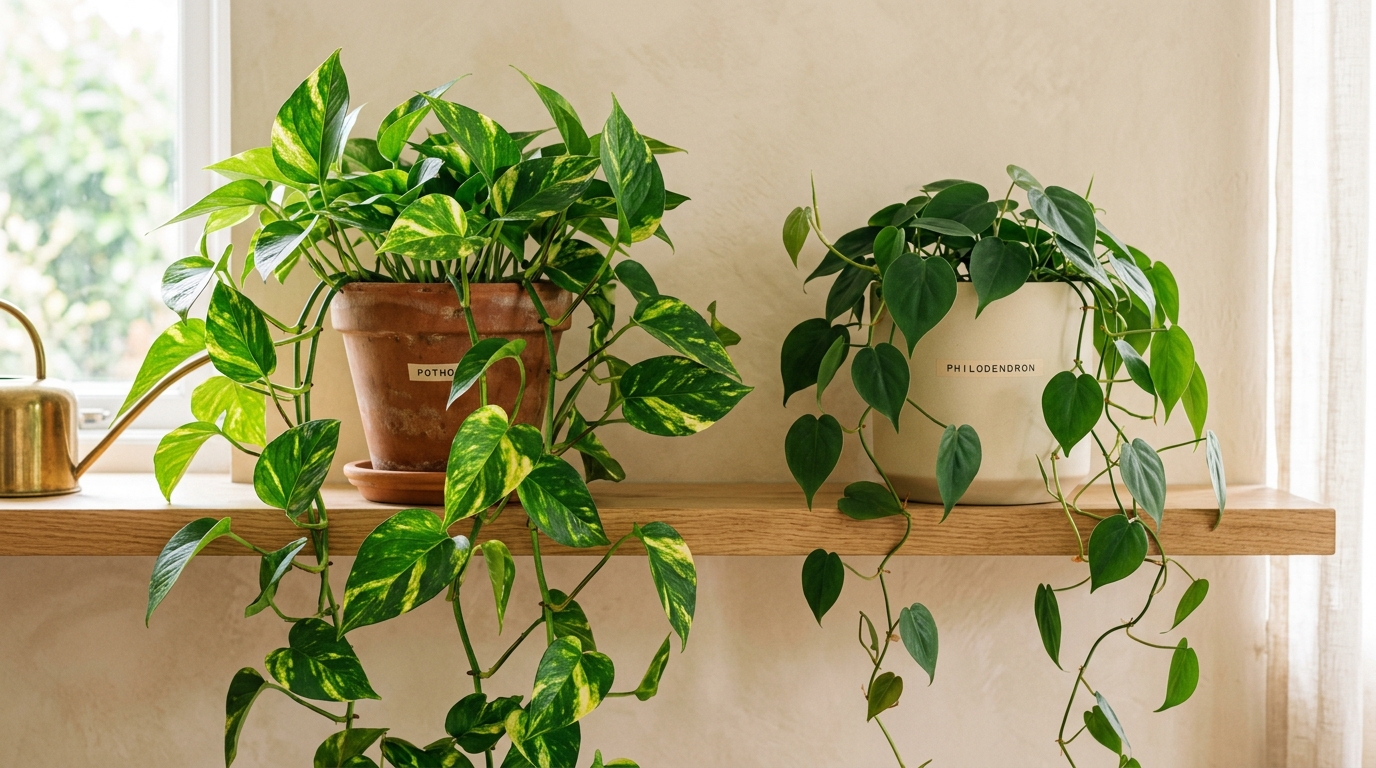

Walk into any plant boutique, nursery, or big-box garden center, and you will almost certainly find these two trailing vines hanging side by side. Both have lush green, heart-shaped foliage. Both send long, cascading tendrils over the rims of hanging baskets. And both are routinely labeled by well-meaning customers—and even distracted greenhouse staff—as "that pothos thing."
The mix-up is so universal that horticulturists, botanists, and boutique owners have all done it. We've done it. The common and botanical names have been tangled for well over a century. Yet untangling them is more than an exercise in academic taxonomy: it is a delightful botany masterclass with an immediate practical payoff.
Once you learn the fundamental architectural signals outlined below, you will never confuse them again, and you'll instantly be able to identify practically every climbing vine in the indoor houseplant aisle.
1. First, the Taxonomy is a Wonderful Mess (And That’s Official)
To understand why everyone mixes up these plants, you have to look at the chaotic history of botanical nomenclature.
The True Identity of "Pothos" (*Epipremnum aureum*)
The plant sitting on millions of office desks and kitchen windowsills known as "Pothos" is not in the genus Pothos at all:
- •In 1880, Belgian botanist Édouard-François André first classified the plant as Pothos aureus.
- •In 1908, as flower morphology was analyzed more closely, botanists moved it into the genus Scindapsus (Scindapsus aureus).
- •In 1962, taxonomists reassigned it to Rhaphidophora (Rhaphidophora aurea).
- •Finally, in 1964, British botanist Monroe R. Birdsey transferred it into the genus Epipremnum (Epipremnum aureum), where it firmly resides today in scientific literature.
Despite sixty years in Epipremnum, the late-19th-century trade moniker "Pothos" stuck stubbornly in commercial commerce. In Southeast Asia, Australia, and the Pacific Islands where it grows wild, it is also known as Devil's Ivy, Ceylon Creeper, and Hunter’s Robe.
The True Identity of Heartleaf Philodendron (*Philodendron hederaceum*)
Meanwhile, the heartleaf philodendron is an authentic, card-carrying member of the genus Philodendron. Originally named Philodendron scandens and Philodendron oxycardium, modern molecular phylogenetics has unified these trailing variants under Philodendron hederaceum (belonging to the subgenus Philodendron).
Cousins in the Arum Family
So, when someone asks us at Ferny's: "Is pothos a type of philodendron?" The rigorous botanical answer is no. They belong to two entirely distinct, non-hybridizing genera (Epipremnum vs. Philodendron).
However, they are close evolutionary cousins: both belong to the Araceae family (the aroids). Like Monsteras, Anthuriums, and Alocasias, both have evolved climbing, hemiepiphytic life strategies in tropical rainforest canopies. Because their survival mechanisms evolved in similar jungle environments, convergent evolution shaped them into near-mirror images.
2. The Definitive Diagnostic: The Cataphyll Sheath
If you only remember one rule from this guide, make it this one. This single morphological feature works on every single specimen, every single time, across every cultivated variety, in any lighting condition:
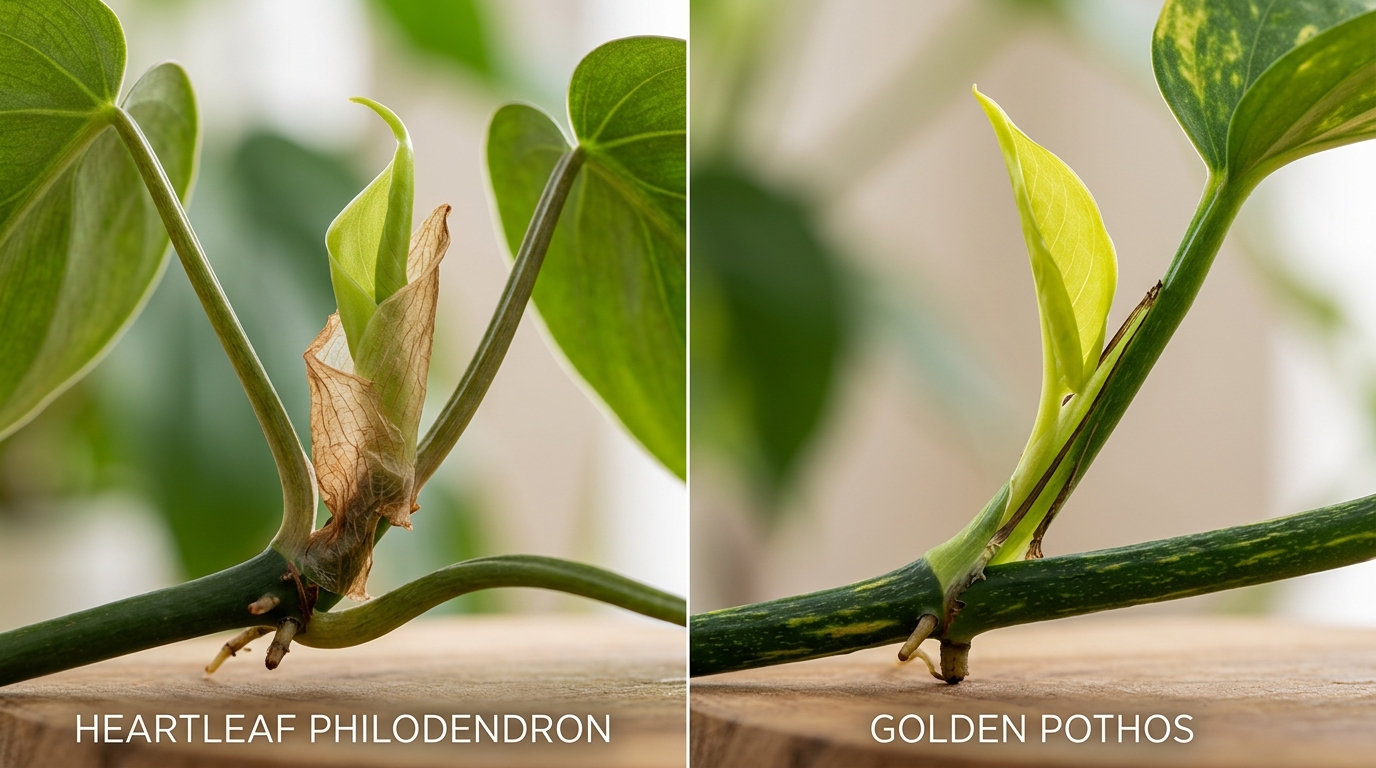
What is a Cataphyll?
A cataphyll is a specialized, reduced, leaf-like organ whose sole biological purpose is to encase and protect a delicate juvenile leaf blade as it develops at the stem apical meristem.
On Philodendrons (*Philodendron hederaceum*):
- •Every new leaf emerges neatly bundled inside a papery, translucent sheath (the cataphyll).
- •As the young leaf swells and pushes outward, it ruptures the cataphyll.
- •Once the leaf blade fully unfurls, the cataphyll's protective job is finished. It dries into a paper-thin, tan or brown husk, curls up, and eventually withers and drops off the vine.
- •If you inspect a mature Philodendron vine, you will see these dried, papery remnants clinging to the stem nodes like shed parchment.
On Pothos (*Epipremnum aureum*):
- •Pothos vines do not possess cataphylls.
- •Instead, a new pothos leaf develops inside the petiole groove (furrow sheath) of the preceding leaf.
- •As it emerges, the leaf simply rolls out of the groove and unfurls directly into the air.
- •There are no papery wrappers, no translucent husks, and zero drying parchment flakes on the stem.
3. Secondary Physical Differences: Leaf Shape, Texture & Petioles
While the presence or absence of cataphylls is the only 100% infallible test, several secondary vegetative characteristics provide strong supporting clues once your eye is trained:
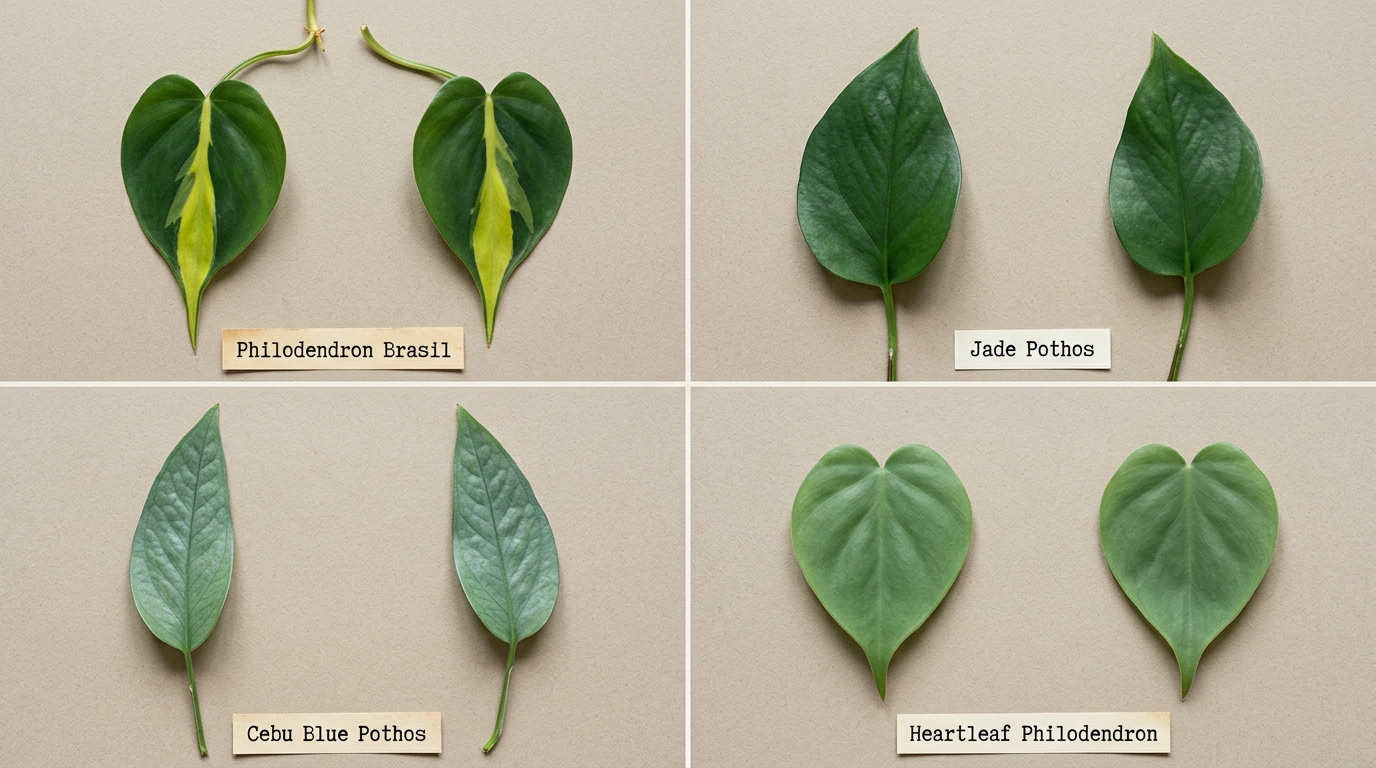
Leaf Shape & Symmetry
- •Heartleaf Philodendron: The leaf base (sinus) is deeply indented, creating a classic, nearly symmetrical sweetheart silhouette. The lobes curve inward dramatically toward the stem, and the leaf tapers smoothly to a sharp, slender, drip-tip apex.
- •Golden Pothos: The leaf shape is broader, more ovate, and visibly asymmetric. If you fold a pothos leaf down its central midrib, the two halves rarely match. One shoulder of the leaf blade is almost always wider or more curved than the other.
Leaf Thickness & Surface Texture
- •Heartleaf Philodendron: The leaves are thinner, more pliable, and delicate. When you run your fingers across the blade, the surface is soft and velvety with a gentle matte or satin finish that absorbs light evenly.
- •Golden Pothos: The foliage is distinctly thicker, leathery, and more succulent. The upper epidermis possesses a thick waxy cuticle that reflects light with a lustrous, glossy sheen. Furthermore, mature pothos leaves often exhibit subtle undulating ridges along the primary veins.
Petiole Architecture (The Leaf Stems)
Take a moment to look at the petiole—the little stem that connects the individual leaf blade to the main vine:
- •The Pothos Petiole Groove: A pothos petiole has a distinct indentation or ridge (a channeled petiole) along its upper surface where the previous leaf unfurled. If you roll the petiole between your thumb and forefinger, you will feel flat edges and a clear U-shaped groove.
- •The Philodendron Petiole Cylinder: A heartleaf philodendron petiole is smooth, slender, and nearly cylindrical or fully rounded in cross-section. It feels like a smooth, curved wire connecting the leaf to the vine node.
Aerial Root Behavior
Both plants produce aerial roots from their nodes to grip tree bark, moss, or trellis walls:
- •Pothos Aerial Roots: Typically produce one thick, stout, nub-like aerial root per node, which remains a blunt brown peg until it contacts moisture or a damp climbing pole.
- •Philodendron Aerial Roots: Frequently produce clusters or bundles of smaller, spindly aerial roots emerging in groups of two to six per node.
4. Comprehensive Botanical Comparison Table
| Botanical Trait | Golden / Marble Pothos (*Epipremnum aureum*) | Heartleaf Philodendron (*Philodendron hederaceum*) |
|---|---|---|
| Genus & Species | Epipremnum aureum | Philodendron hederaceum |
| Family | Araceae (Aroid) | Araceae (Aroid) |
| New Leaf Protection | No cataphyll; unfolds from petiole groove | Papery cataphyll sheath that dries and sheds |
| Leaf Texture | Thick, leathery, glossy, waxy cuticle | Soft, thin, flexible, matte to satin finish |
| Leaf Symmetry | Asymmetric, ovate heart shape | Highly symmetrical, classic curved heart |
| Petiole Cross-Section | Channeled with a prominent U-groove | Smooth, circular to rounded wire |
| Aerial Roots | Usually 1 thick, stout root per node | Often small clusters of 2–6 spindly rootlets |
| Low-Light Tolerance | Exceptional; survives deep office shade | Very good; prefers bright indirect light |
| Drought Forgiveness | Tolerates drying to 75%; thick leaves store water | Thinner leaves droop faster when parched |
| Cold Tolerance | Vulnerable below 50°F (10°C) | Slightly more cold-tolerant (down to 45°F / 7°C) |
| Mature Giant Form | Climbs to 40+ ft with giant split fenestrations | Climbs up to 20 ft; leaves enlarge without splits |
| Toxicity to Pets | Toxic (Insoluble calcium oxalate crystals) | Toxic (Insoluble calcium oxalate crystals) |
5. The Cultivars That Genuinely Confuse People
While standard green heartleaf philodendron and golden pothos are relatively easy to differentiate, certain specialized cultivars cause widespread confusion in nurseries:
1. *Philodendron hederaceum* 'Brasil' vs. Jade Pothos
- •The Confusion: 'Brasil' features an electric lime-yellow and gold brushstroke running straight down the center midrib of a dark green heart leaf. Beginners often see light variation on a jade pothos and think it's a brasil.
- •The Instant Fix: Look at the vine nodes. 'Brasil' produces vibrant peach, pink, or lime-tinted cataphylls that encase each emerging leaf before drying to a tan husk. A jade pothos leaf emerges naked from its petiole furrow with no wrapper.
2. Cebu Blue Pothos (*Epipremnum pinnatum* 'Cebu Blue')
- •The Confusion: Cebu Blue has elongated, arrow-shaped, silvery-blue foliage that looks completely unlike a standard golden pothos. Many hobbyists mistake it for a rare juvenile philodendron.
- •The Instant Fix: It is indeed an Epipremnum pinnatum. As it climbs a cedar plank or sphagnum moss pole, mature leaves expand into massive 24-inch pinnate blades with dramatic fenestrations (slits) resembling a Monstera!
3. Velvet Leaf Philodendron (*Philodendron hederaceum var. micans*)
- •The Confusion: Often called "Micans," this beloved vine has heart-shaped leaves that shimmer with iridescent bronze, deep burgundy, and rust undertones under natural light. In dim shop lighting, people grab the wrong one constantly.
- •The Reality: While the leaf shape resembles a small pothos, the velvet pubescence on the leaf surface and the presence of prominent cataphylls unmistakably mark it as a true philodendron.
4. Pink Princess Philodendron (*Philodendron erubescens*)
- •The Variegated Royalty: An upright climbing philodendron famous for its bubblegum pink sectoral patterns. Prune back to variegated nodes as explained in our [Pink Princess Philodendron Care Guide](/blog/pink-princess-philodendron-care-and-price-guide).
6. Care & Cultivation: The Inside Joke
Here is the delightful irony of the entire debate: their cultural care requirements are almost identical.
If you accidentally purchase a Heartleaf Philodendron thinking it was a Golden Pothos (or vice versa), your plant will not suffer. Both are hardy tropical understory vines evolved for low-maintenance indoor companionship:
1. Light Requirements
- •Pothos: Highly adaptable. Survives in dim, fluorescent-lit interior offices better than almost any other houseplant on Earth. However, to maintain vibrant golden or creamy white marbling (as in Marble Queen Pothos), supply bright, indirect light.
- •Philodendron: Prefers medium to bright, dappled indirect light. In extremely deep shade, heartleaf philodendrons become leggy and their internodal spacing stretches out faster than pothos.
- •Use our free [Houseplant Light Calculator](/tools/houseplant-light-calculator) to check your window orientation and foot-candle levels.
2. Watering Rhythms
- •Both plants prefer the "soak and dry" method. Never water on a rigid calendar.
- •Insert your finger two knuckles deep into the substrate. Allow the top 50% of the pot volume to dry out between waterings.
- •When parched, pothos leaves become soft and slightly curled, while philodendron leaves droop limply and lose their petiole tension. Both perk up within two hours of a thorough drench.
- •Calculate custom watering frequency using our [Houseplant Watering Calculator](/tools/houseplant-watering-calculator).
3. Soil & Potting Substrate
- •In nature, both species climb trees as epiphytes. Heavy, compact potting dirt will cause anaerobic root rot.
- •House both vines in a loose, aerated potting mix containing 60% coco coir/peat, 25% coarse horticultural perlite, and 15% orchid bark.
- •Formulate custom potting volume batches with our free [Potting Soil Recipe Calculator](/tools/potting-soil-recipe-calculator).
7. Pet Safety & Toxicity: A Critical Reality Check
A pervasive myth among indoor plant enthusiasts is that one of these two plants is completely safe for pets, while the other is poisonous.
This is completely false. According to the American Society for the Prevention of Cruelty to Animals (ASPCA), both Pothos (Epipremnum aureum) and Philodendron (Philodendron hederaceum) are toxic to cats and dogs.
The Biochemical Mechanism: Calcium Oxalate Crystals
Neither plant contains chemical toxins that cause acute organ or kidney failure (unlike true Lilium species in cats). Instead, their cellular tissue is packed with microscopic, needle-shaped crystals called insoluble calcium oxalate raphides:
8. Frequently Asked Questions
Is pothos a philodendron?
No. Pothos is the common name for Epipremnum aureum, a different genus in the same plant family (Araceae). The name "pothos" stuck from an 1880 classification that has since been reclassified three times. Both are aroids, which is why they look and behave so similarly.
Which is easier, pothos or philodendron?
They're nearly identical in care requirements. If you forced a ranking, pothos tolerates dimmer corners slightly better and philodendron is slightly more sensitive to inconsistent watering. For a beginner, either one is a safe first plant.
Are pothos and philodendron both toxic to cats?
Yes. Both contain insoluble calcium oxalate crystals, which cause oral irritation, drooling, and vomiting if chewed, per the ASPCA. Neither is deadly like lilies, but keep both out of reach of pets who chew plants. If your cat eats some, rinse its mouth with cool water or milk and call your vet.
Can you plant pothos and philodendron together in the same pot?
Yes! Because their light, moisture, and soil chemistry requirements are identical, planting a golden pothos alongside a heartleaf philodendron creates a striking dual-textured container arrangement with contrasting glossy and matte foliage.
Botanical References & Scientific Sources
- •ASPCA Animal Poison Control Center: Toxic and Non-Toxic Plants database (Epipremnum aureum & Philodendron hederaceum).
- •Missouri Botanical Garden: Plant Finder Database (Epipremnum aureum & Philodendron hederaceum cultural biology).
- •Royal Botanic Gardens, Kew: Plants of the World Online (POWO) for current Epipremnum and Philodendron taxonomy.
At Ferny's, both pothos and heartleaf philodendrons are usually in stock in several varieties—including our greenhouse-grown [Marble Queen Pothos](/shop/marble-queen-pothos). And if you bring us a mystery vine at Plant Club LA, we'll ID it on the spot! It's our favorite kind of party trick.
Frequently Asked Questions
Q: Is pothos a philodendron?
No. Pothos is the common name for Epipremnum aureum, a different genus in the Araceae family. The name stuck from an 1880 classification that has since been reclassified three times.
Q: Which is easier, pothos or philodendron?
They are nearly identical in care requirements. Pothos tolerates dimmer corners slightly better, while philodendron is slightly more forgiving of inconsistent watering.
Q: Are pothos and philodendron both toxic to cats and dogs?
Yes. Both contain insoluble calcium oxalate crystals, which cause localized oral burning, drooling, and vomiting if chewed, per the ASPCA.
Shop Botanicals Mentioned in This Story
Bring the living plants and tools from this article straight into your home.


More from The Journal
View All Stories →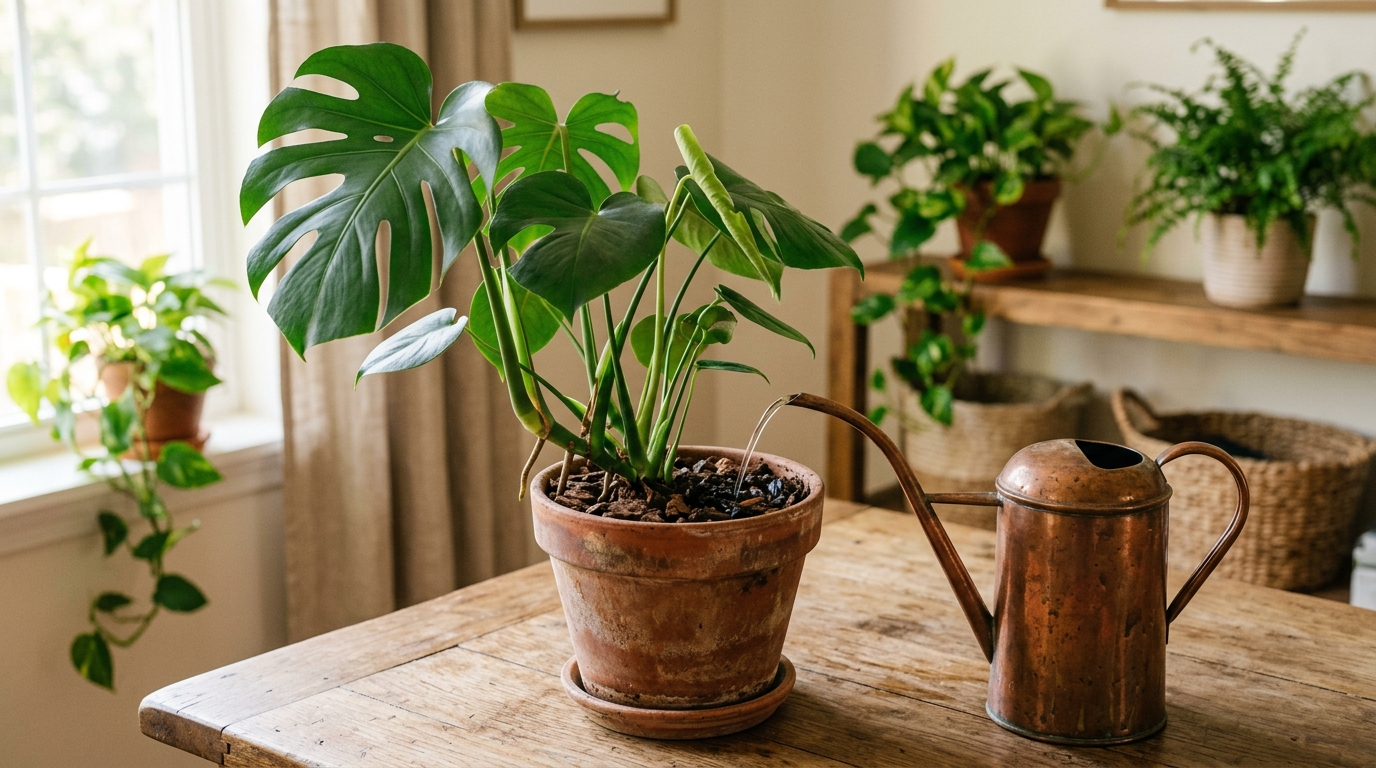
How Often to Water a Monstera (Schedule by Season)
Stop guessing on a rigid calendar. Discover how light, pot material, and seasonal growth cycles dictate your Monstera’s exact hydration needs—with a printable cheat-sheet.
Elena Vance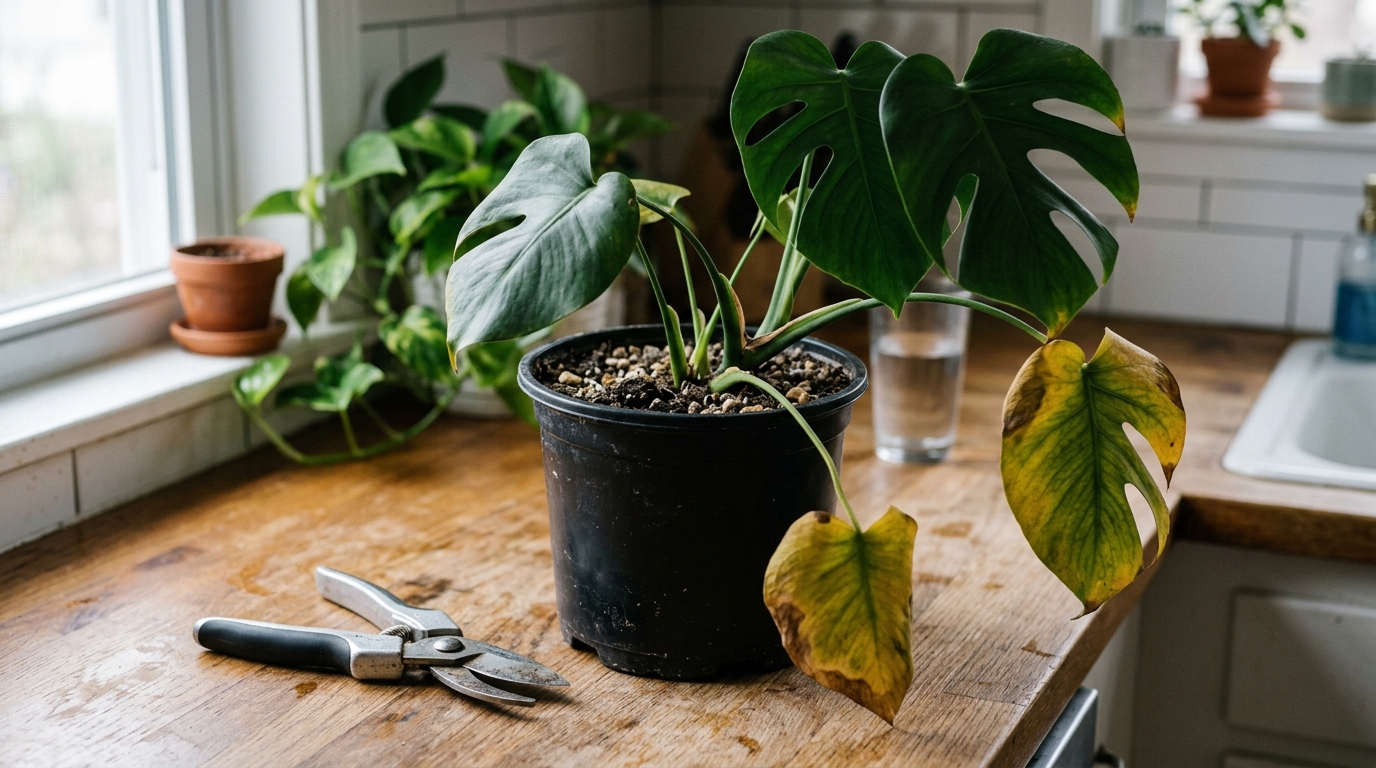
Why Is My Monstera Dying? 7 Fixes for Yellow Leaves, Root Rot & Drooping
Do not panic when your prized Monstera develops yellow leaves or limp stems. Follow our emergency triage protocol to diagnose root rot, shock, or pests—and nurse it back to life.
Elena Vance