How Often to Water a Monstera (Schedule by Season)
Stop guessing on a rigid calendar. Discover how light, pot material, and seasonal growth cycles dictate your Monstera’s exact hydration needs—with a printable cheat-sheet.

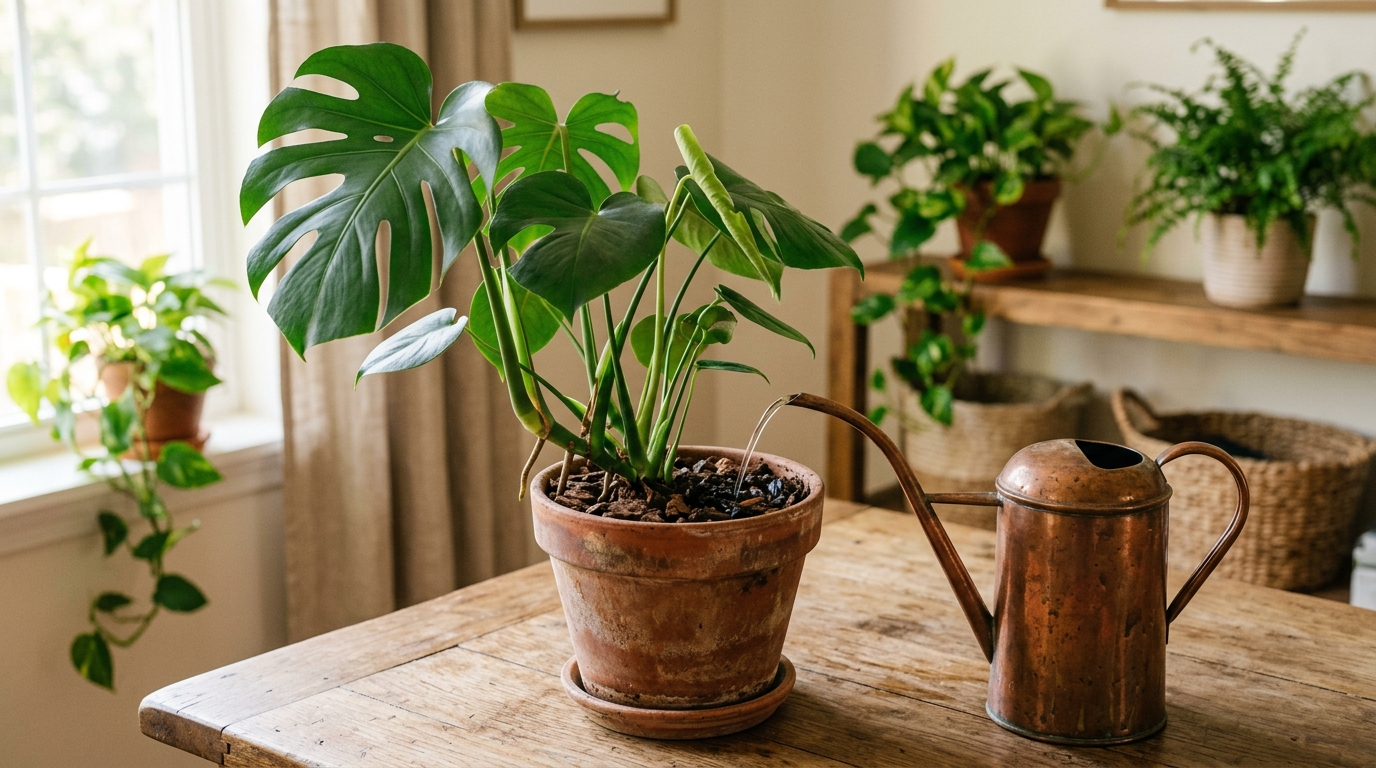

If there is one universal myth that turns vibrant tropical houseplants into yellowing compost, it is the advice to "water your Monstera once a week on Sunday."
In their native Central and South American rainforest canopies, Monstera deliciosa are hemiepiphytic climbing vines. In nature, they germinate on the forest floor, quickly climb upward toward the canopy along host tree trunks, and anchor themselves with thick, aerial root systems. Their roots are adapted to experience torrential monsoon downpours followed immediately by fast drying cycles, driven by warm breezes and loose canopy debris.
When we bring a Monstera indoors and pack it into dense potting soil, watering on a strict calendar ignores the biological reality of how plants drink. According to horticultural research from the University of Florida (UF/IFAS Extension HS311), tropical aroids regulate water uptake dynamically based on ambient photon levels (light intensity), ambient temperature, relative humidity, and vegetative transpiration rates. To keep your Monstera flourishing with gigantic, perforated split leaves, you must water according to substrate moisture assessment and seasonal growth phases, not the day of the week.
1. The Seasonal Monstera Watering Schedule
Your indoor microclimate shifts dramatically between scorching July afternoons and chilly December mornings. When heating kicks on or air conditioners run, transpiration rates change by up to 300%. Here is how your watering cadence must adjust across the four seasons:
| Season | Typical Indoor Frequency | Substrate Rule | What the Plant is Doing |
|---|---|---|---|
| Spring (March – May) | Every 7 – 10 Days | Check soil every 3–4 days; let top 2–3 inches dry out | Awakening from winter semi-dormancy; unfurling delicate pale green juvenile leaves and establishing new root hairs. |
| Summer (June – August) | Every 5 – 7 Days | Check soil every 2–3 days; let top 2 inches dry out | Peak active vegetative growth; high transpiration and rapid soil moisture depletion under long daylight hours. |
| Fall (Sept – Nov) | Every 10 – 14 Days | Check soil every 5–7 days; let top 50% dry out | Metabolism slowing as daylight hours shorten; vegetative growth tapers off. |
| Winter (Dec – Feb) | Every 2 – 3 Weeks | Check weekly; let top 65–75% of soil dry out | Semi-dormancy; roots absorb minimal moisture. Cold + wet soil equals fatal fungal root rot. |
Treat that table as an educational starting point, not gospel. A Monstera in a porous terracotta pot by a sunny south window will drink twice as fast as one in a plastic pot in a dim hallway. The table tells you roughly when to start checking, and checking is the actual skill of plant parenthood.
2. How to Check: The 2-Knuckle Soil Test
Stick your index finger into the potting mix up to the second knuckle, approximately two to three inches deep:
- •If soil clings to your skin and feels cool and damp: Wait. There is plenty of available capillary moisture around the upper root zone.
- •If your finger comes out clean and dusty dry at two inches: It is time to water thoroughly.
- •The Chopstick Alternative: A wooden chopstick or bamboo skewer works the same way: slide it all the way to the bottom of the pot. If it pulls out with dark, moist soil clinging to the wood, the lower roots are still hydrated.
We prefer the knuckle test to cheap electronic moisture meters for most people because your finger is free and surprisingly accurate. If you want a meter anyway, buy a dedicated probe that reads moisture only—skip the 3-in-1 gadgets with the light and pH probes, as the light sensor is a toy.
When you do water, water thoroughly. Take the plant to the sink or put a deep saucer under it and pour room-temperature water evenly across the surface until water runs freely out of the bottom drainage holes. Let it drain fully for 15 minutes, and then empty the saucer. Shallow sips of water every few days are worse than a real soak followed by a proper dry-down, because the wet surface layer invites fungus gnats while the root tips below stay thirsty.
3. What Actually Changes the Schedule
4. Overwatering vs Underwatering: How to Tell Them Apart
Because both problems cause leaves to droop, many plant parents mistake a drowning plant for a thirsty one:
- •Underwatering Looks Like: Limp or drooping leaves that feel papery and thin, crispy brown tips and leaf edges, older leaves yellowing in a dry brittle way, and dry soil pulling away from the pot's perimeter.
- •The Fix: A thorough bottom-soak bath in lukewarm water for 30 minutes. The plant usually perks up within 24 hours.
- •Overwatering Looks Like: Lower leaves turning soft pale yellow, leaves feeling limp yet heavy and waterlogged, a swampy sour odor from the soil, and in advanced cases black mushy stems at the base.
- •The Fix: Stop watering immediately. Allow the root zone to aerate. If stems feel soft, consult our emergency triage steps in [Why Is My Monstera Dying?](/blog/why-is-my-monstera-dying-fixes-yellow-leaves-root-rot).
5. Drainage: The One Non-Negotiable Rule
Whatever else you do, your pot must have drainage holes. A Monstera potted directly into a solid decorative vessel with no holes is a slow-motion drowning, no matter how disciplined you are with your watering can.
If you love a decorative ceramic pot without holes, keep the Monstera in its plastic nursery pot inside as a cachepot, and lift it out to water. Always plant in an airy substrate like our [Chunky Forest Aroid Potting Mix](/shop/chunky-forest-aroid-potting-mix).
6. Printable Monstera Watering Cheat-Sheet
Frequently Asked Questions
How do I know when my Monstera needs water?
Check the soil, not the leaves. If the top 2–3 inches are dry to the touch, water thoroughly until water drains from the bottom. Drooping leaves alone can indicate either underwatering or advanced root rot, so the knuckle test is your only reliable indicator.
Should I water my Monstera more in the summer?
Yes. Increased daylight hours and warmer ambient temperatures accelerate photosynthesis and transpiration. Most indoor Monsteras need water every 5–7 days in summer compared to every 2–3 weeks in winter.
Can I bottom-water my Monstera?
Yes! Bottom-watering is an exceptional method if your soil has become hydrophobic and contracted from the sides of the pot. Place the nursery pot in 3 inches of water for 30 minutes, then drain thoroughly.
Botanical Sources & Citations
- •University of Florida IFAS Extension: EDIS Publication HS311, "Monstera Growing in the Florida Home Landscape" (Crane and Balerdi).
- •Missouri Botanical Garden: Plant Finder Database, Monstera deliciosa culture.
- •ASPCA Animal Poison Control: Toxicity guidance for Araceae houseplants.
Looking for an authentic, greenhouse-acclimated plant? Explore our signature [Monstera Deliciosa](/shop/monstera-deliciosa) and [Monstera Moss Pole Bundle](/shop/monstera-deliciosa-moss-pole-bundle) at Ferny's.
Frequently Asked Questions
Q: How do I know when my Monstera needs water?
Check the soil, not the leaves. If the top 2-3 inches are dry to the touch, water thoroughly until it drains from the bottom. Drooping leaves alone can mean either too much or too little water, so the knuckle test is the tiebreaker.
Q: Should I water my Monstera more in summer?
Usually yes, because more light and warmth mean faster growth and faster water use. In bright summer conditions many indoor monsteras need water every 5-7 days versus every 2-3 weeks in winter.
Shop Botanicals Mentioned in This Story
Bring the living plants and tools from this article straight into your home.



Monstera Deliciosa + Sphagnum Moss Pole Bundle
Monstera deliciosa
More from The Journal
View All Stories →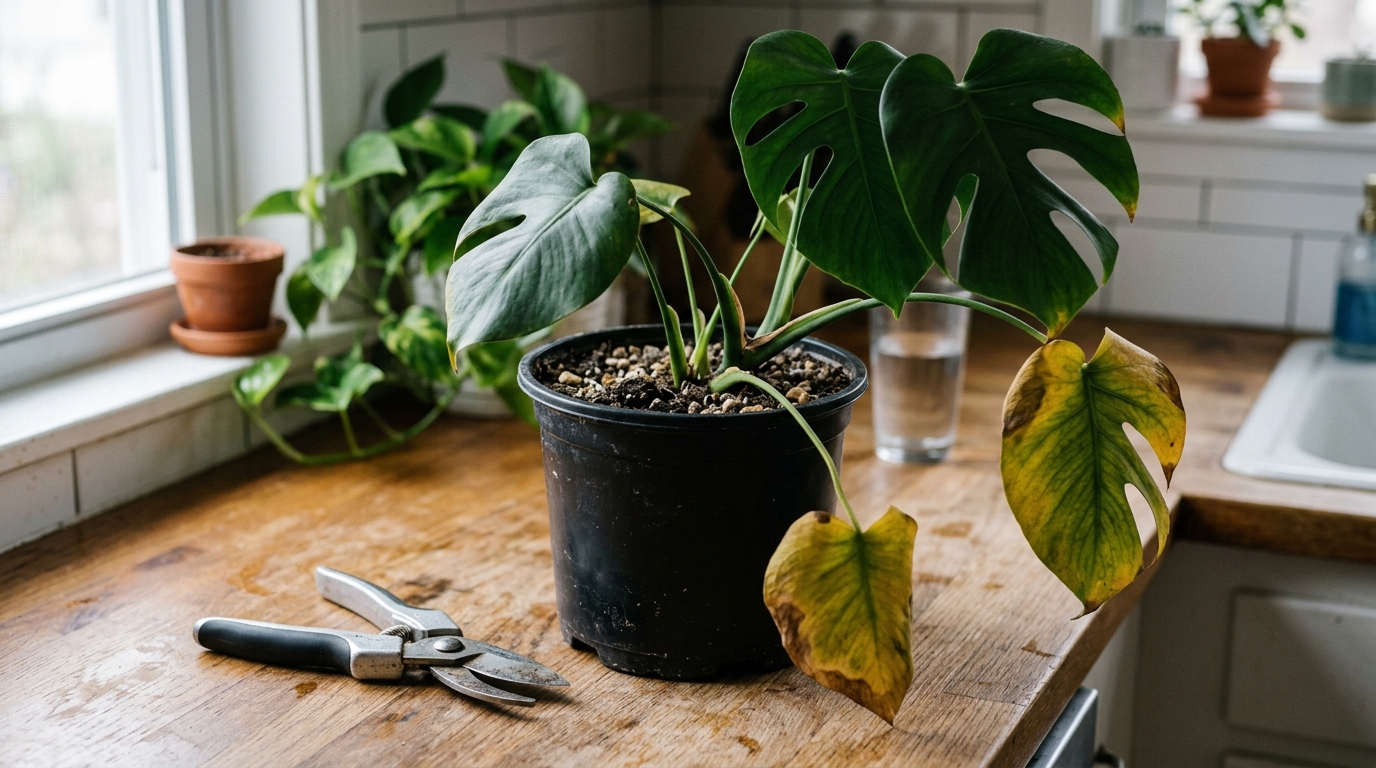
Why Is My Monstera Dying? 7 Fixes for Yellow Leaves, Root Rot & Drooping
Do not panic when your prized Monstera develops yellow leaves or limp stems. Follow our emergency triage protocol to diagnose root rot, shock, or pests—and nurse it back to life.
Elena Vance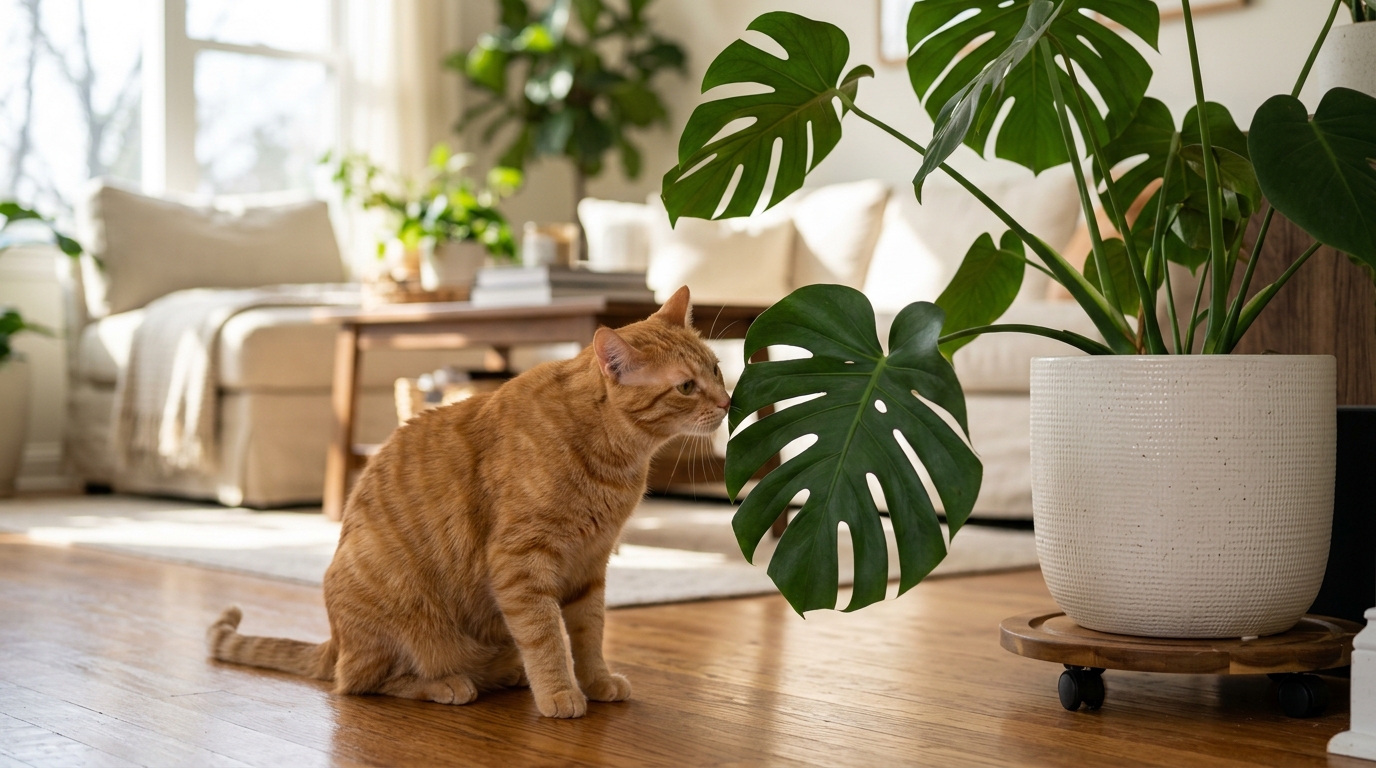
Are Monstera Toxic to Cats & Dogs? A Pet-Safety Guide
Everything pet owners need to know about Monstera toxicity, insoluble calcium oxalate crystals, emergency first-aid protocols, and 12 gorgeous pet-safe alternatives.
 Marcus Chen